Apple Watch Balke Test: Hands-Free VO2 Max
How to run the 15-minute Balke test on your Apple Watch. Hands-free pacing, no track measurement, plus the regression that turns distance into VO2 max.
The Balke test is a 15-minute timed run that estimates VO2 max from your average velocity. Run on the Apple Watch, the timer, the distance, and the regression are all handled for you. The 15-minute window pushes you closer to your true aerobic ceiling than the 12-minute Cooper test, which is why I prefer it for trained subjects.
The protocol below is the one I run on myself every 4 to 6 weeks.
Bruno Balke developed this protocol at the USAF School of Aviation Medicine in 1963, three years before Cooper published the shorter version. Both produce VO2 max estimates within 2 to 3 mL/kg/min of a lab gas-exchange test when paced correctly. The choice between them is mostly about how much pacing tolerance you have left at the 12-minute mark.
What does the Balke test measure?
The fastest sustained pace your aerobic system can hold over 15 minutes. That window matches the time-to-exhaustion zone that maps cleanly onto VO2 max for trained subjects. The output is an average velocity, which converts to VO2 max via a regression equation similar to the one used for the 1.5-mile run.
For trained endurance athletes the extra three minutes over the Cooper test produces a slightly more accurate VO2 max estimate, because you finish closer to your true sustainable ceiling rather than with energy in reserve. Untrained or moderately fit subjects sometimes find the 15-minute window punishing, and the longer effort introduces more pacing variance, which is why the Cooper remains the more popular choice for first-time testers.
Why run the Balke test on the Apple Watch?
The Watch handles the three pieces of friction that complicate a stopwatch version of the test: the 15-minute timer, the distance measurement (via GPS), and the regression math. You get a single screen at the end with your distance, your average pace, and your VO2 max estimate. The same hands-free advantage applies to the Cooper version on the Apple Watch, the Yoyo version, and the Watch-based beep test.
Apple Watch GPS accuracy on an open route runs at roughly plus or minus 1.5 percent of measured distance, based on controlled testing across the Series 8 and Ultra 2. That uncertainty translates to about 5 to 8 seconds across a 15-minute Balke effort. Your pacing variance will dwarf that error in almost every case, so do not lose sleep over the GPS itself.
How do you run a clean Balke test?
Three steps. Warm up for 10 minutes, including 4 progressive strides. Start an Outdoor Run on the Apple Watch and run as far as you can in exactly 15 minutes. Stop the workout the instant the Watch announces 15:00 and read the distance.
Two settings matter before you start. Set the Workout View so the largest tile shows current pace, not heart rate. Pacing on heart rate alone fails because the optical signal lags 30 to 60 seconds behind reality, and that lag is the difference between a clean 15-minute effort and a blow-up at 11:30. Disable Auto-Pause so the Watch does not decide for you when a slow patch counts as a stop.
The course matters too. Run on a flat 400-meter track or a flat measured loop. Hilly courses introduce pacing problems that no algorithm can correct for. If your only option is rolling terrain, accept that the Balke estimate will be 3 to 5 mL/kg/min off in either direction.
What pacing strategy works for the Balke test?
Even-pace it. Aim for the same pace you can hold for 15 minutes flat-out, then run that pace from the gun. The temptation to bank distance in the first 800 meters is the single biggest reason Balke results come back lower than the runner expected.
The honest goal pace for most trained adults sits somewhere between their 5k race pace and their 10k race pace. If you do not have those reference points, run a Cooper or 1.5-mile test first, calculate your goal Balke pace from that result, and use the Balke a week later. The full comparison of pacing demands across the field tests is in the beep test alternatives ranked, and the broader case for running multiple field tests in rotation is in lab and wearable testing options.
How accurate is the Apple Watch Balke result?
Within 2 to 3 mL/kg/min of a lab gas-exchange test in trained subjects, when the run is paced cleanly. That is slightly tighter than the Cooper test for the same subjects, because the longer window flattens out small early-pacing errors. The Watch itself adds essentially no error to the protocol.
The errors that do show up are runner-side, not device-side. Heat above 22 degrees Celsius cuts the result by 5 to 15 percent. Sleep deprivation knocks 1 to 4 percent off your sustainable pace. Dehydration of even 2 percent body mass reduces VO2 max performance noticeably. The full troubleshooting checklist is in why VO2 max readings keep changing. If your Balke number disagrees with how you feel, work through that list before suspecting the Watch.
Frequently asked questions
Should I pick the Balke test or the Cooper test? Cooper for first-time testers and pacing-uncertain runners. Balke for trained endurance athletes who want a more accurate ceiling estimate. Both are valid.
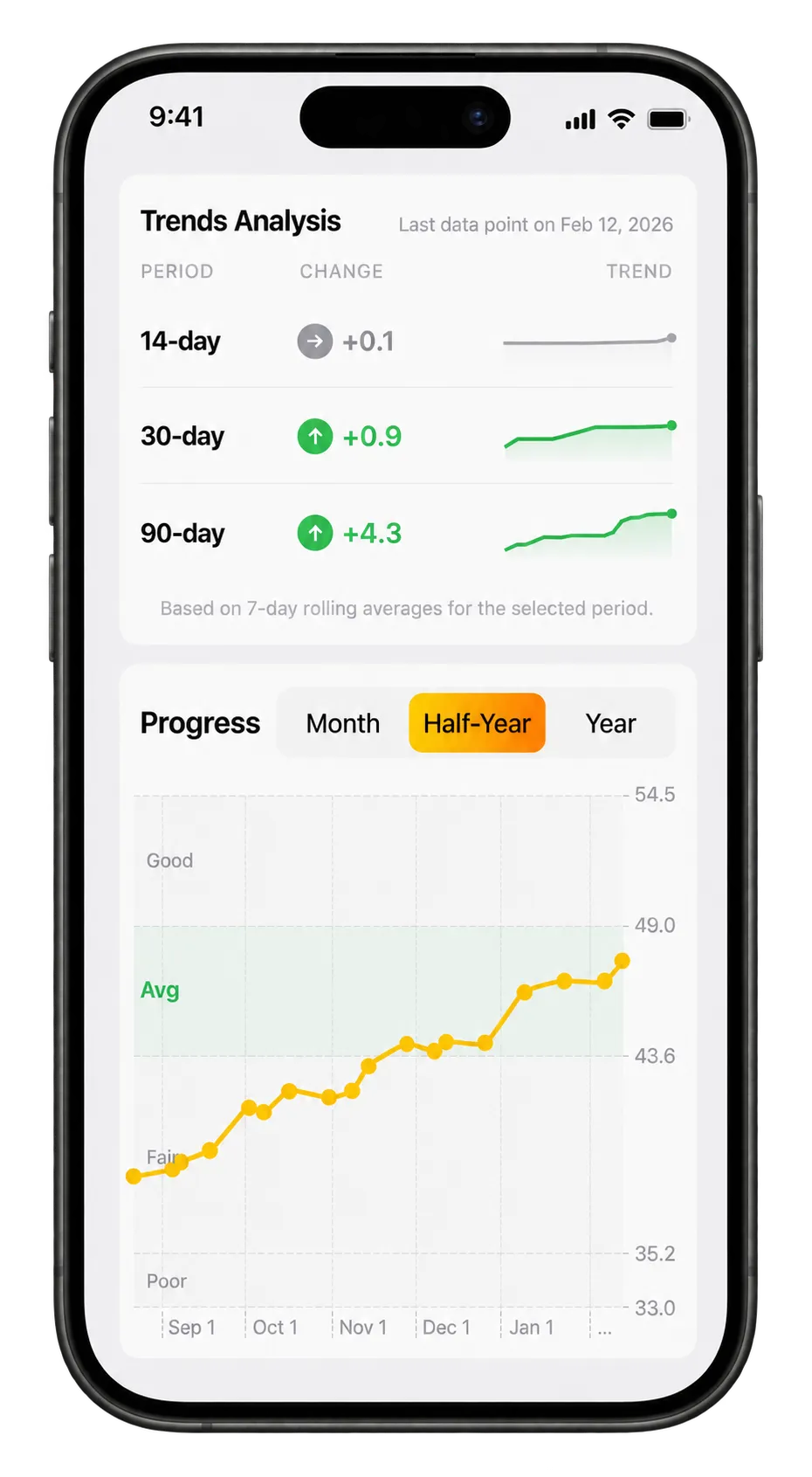 VO2 Max progression tracking directly in the iPhone app.
Can I run the Balke on a treadmill? Yes, with the incline at 1 percent to compensate for missing wind resistance. The Watch tracks treadmill workouts via accelerometer-derived pace, which calibrates better after one outdoor run.
How often should I retest? Every 4 to 6 weeks during a training block. More often than that mostly captures pacing noise, not real fitness changes.
Running the Balke without doing the regression math by hand? Vo2 Maximizer handles the 15-minute timer, the GPS distance, and the Balke regression on your Apple Watch, then files the result alongside your Cooper, Yoyo, beep, and 1.5-mile history so you can spot the trend across tests.