Apple Watch Cooper Test: Hands-Free VO2 Max
Run the Cooper 12-minute test from your Apple Watch with no stopwatch. Setup, pacing, and the regression that converts distance into a clean VO2 max number.
The Cooper 12-minute run is the most validated self-paced field test for VO2 max. Run on the Apple Watch, the timer, the distance, and the regression are all handled for you. The protocol below is the one Kenneth Cooper validated against direct gas exchange in 1968 with a correlation of r = 0.90, and it remains the cleanest field test for general fitness use four decades later.
I have run the Cooper test on the Apple Watch every 4 to 6 weeks for two years. The number tracks well against my lab measurements, and the wrist setup eliminates the friction of carrying a stopwatch and pacing against a measured loop. The advantages compound: same protocol every session, same algorithm reading the distance, no scrambling for a track that was already measured.
What does the Cooper test actually measure?
How far you can run in 12 minutes. The estimation formula converts total distance into a VO2 max number using the regression Kenneth Cooper published in JAMA (1968): VO2 max (mL/kg/min) = (distance in meters minus 504.9) divided by 44.73. A 2,800-meter result lands you near 51 mL/kg/min. A 3,200-meter result lands at about 60.
Cooper validated the equation against direct gas-exchange testing on 115 US Air Force subjects and reported the r = 0.90 correlation with measured VO2 max. That correlation has held up reasonably well in later replications, though the estimate over-rates highly trained subjects slightly because the 12-minute window does not push them all the way to their true ceiling. For moderately fit adults, which is most readers, the formula is solid.
Why run the Cooper test on the Apple Watch?
The Watch handles three pieces of friction that cost time and accuracy on a stopwatch version: the 12-minute timer, the GPS distance measurement, and the regression math. You get one screen at the end with your distance, your pace, and your VO2 max number. The same hands-free pattern shows up in the Balke version on the Apple Watch, the Yoyo version, and the Apple Watch beep test.
Apple Watch GPS accuracy on an open route runs at roughly plus or minus 1.5 percent of measured distance. Across a 2,800 to 3,200 meter Cooper effort that translates to about 40 to 50 meters of distance uncertainty, which is roughly 1 mL/kg/min in VO2 max terms. Your pacing variance will dwarf that error in almost every case, so the Watch is good enough for the test it is asked to run.
How do you run a clean Cooper test?
Three steps. Warm up for 10 minutes with easy jogging and 4 progressive strides. Start an Outdoor Run on the Apple Watch and run as far as possible in 12 minutes. Stop the workout the instant the Watch announces 12:00 and read the distance.
Two settings are worth getting right before your first attempt. Set the Workout View so the largest tile shows current pace, not heart rate. Pacing on heart rate fails because the optical signal lags real exertion by 30 to 60 seconds. Disable Auto-Pause so the Watch does not freeze the timer if you slow down briefly. Both settings stick across sessions but sometimes reset after a major watchOS update, so confirm them before each test if it has been a few weeks.
What pacing strategy works best?
Even-pace it from the gun. Aim for the pace you can hold for 12 minutes with everything you have, then hold that pace through the first kilometer. The temptation to bank distance in the first 400 meters is the single biggest reason Cooper results come back under-cooked.
If you do not know your goal pace, your 5k race pace plus 10 to 15 seconds per kilometer is a reasonable starting estimate. The first session is calibration. The second and third sessions are where you start producing reliable comparable numbers. Most runners need 2 to 3 attempts before their pacing settles, and the spread between those early sessions is mostly pacing noise rather than fitness drift. The full ranked comparison across field tests is in the beep test alternatives ranked, and the lab and wearable comparison sits in lab versus field versus watch.
How accurate is the Cooper test on the wrist?
Within 3 to 5 mL/kg/min of a lab gas-exchange test in trained subjects, when the run is paced cleanly. That accuracy band matches the published standard error of the Cooper formula and the typical Apple Watch GPS variance combined.
The errors that do show up are environmental and personal. Heat above 22 degrees Celsius cuts performance by 5 to 15 percent in field conditions. A single night of poor sleep reduces sustainable pace by 1 to 4 percent. Dehydration of 2 percent body mass cuts VO2 max performance by 5 to 10 percent. The same five variables that drive noise in any field test apply here, and the troubleshooting list in why VO2 max scores fluctuate covers them all.
Frequently asked questions
Should I pick the Cooper test or the 1.5-mile run? Cooper for distance-based scoring, 1.5-mile for time-based scoring. They produce equivalent VO2 max estimates with different units of measurement. Pick whichever your sport or program already uses.
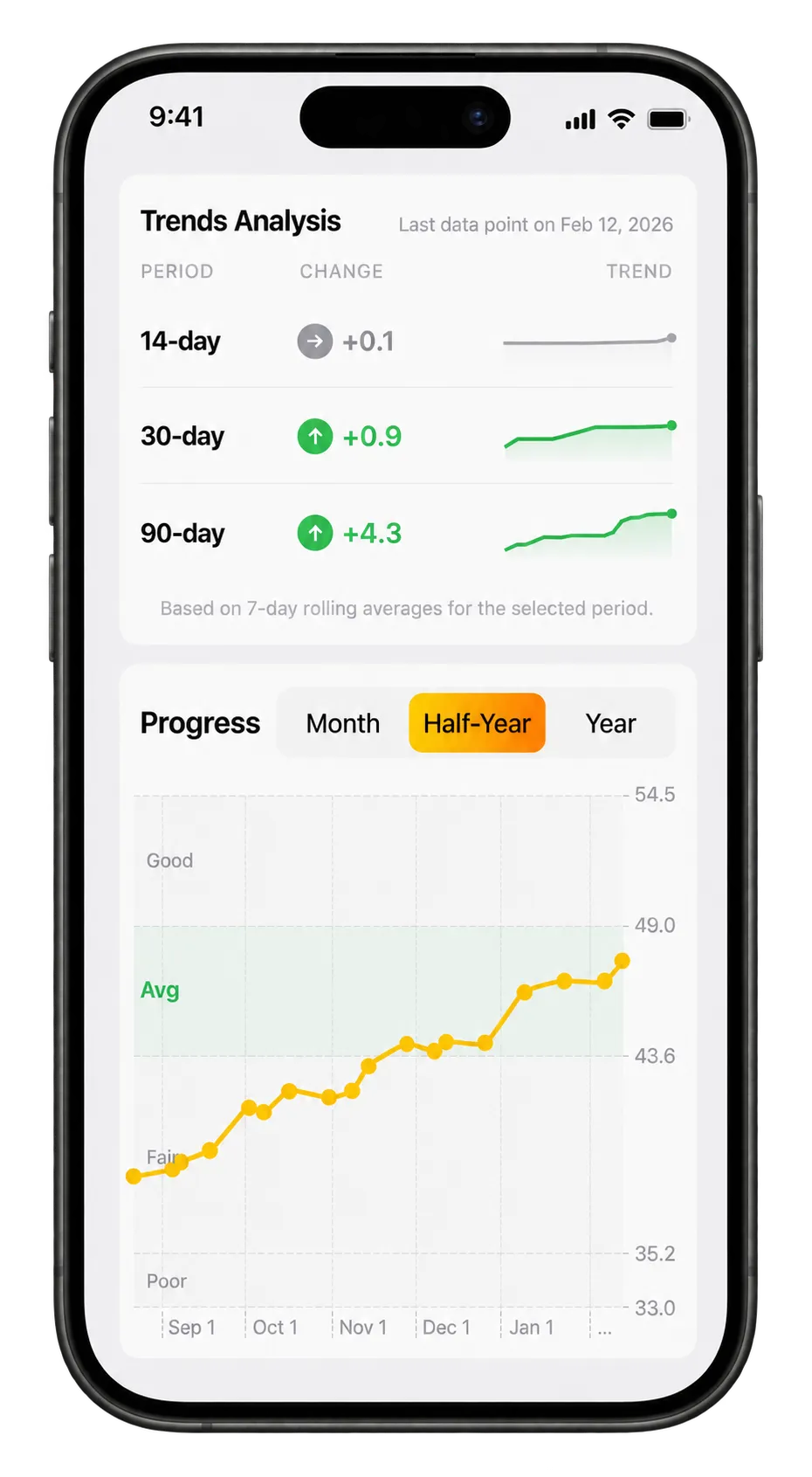 VO2 Max progression tracking directly in the iPhone app.
Can I run the Cooper test on a treadmill? Yes, with the incline at 1 percent to compensate for the missing wind resistance. Calibrate the Watch with one outdoor run first so the treadmill stride length is accurate.
How does altitude affect the Cooper result? Above 1,500 meters elevation, expect a 3 to 5 percent reduction in distance for the same physiological effort. Run at the same elevation if you want comparable trend lines over time.
Running the Cooper test without doing the math by hand? Vo2 Maximizer handles the 12-minute timer, the GPS distance, and the Cooper regression on your Apple Watch, and stores every result alongside your Balke, Yoyo, beep, and 1.5-mile history so you can spot the trend across methods.