

Lab vs Field vs Watch: VO2 Max Testing Compared
TL;DR. Three families of VO2 max tests are worth your time: laboratory gas exchange (the reference, accurate to within 1 to 2 mL/kg/min, costs 200 to 500 dollars), validated field tests like the Cooper, Balke, Yoyo, beep, and 1.5-mile run (within 3 to 5 mL/kg/min, free), and wrist-watch estimates from Apple Watch or Garmin (within 5 to 8 mL/kg/min, passive). Each one solves a different problem. The question is which problem you actually have.
I have made lab tests at two universities and field tests on dozens of weekends, and I wear an Apple Watch every day. The three numbers from those three sources never agree exactly. They disagree in predictable ways, and once you understand why, you can use all three together rather than picking a favorite and ignoring the others. That triangulation is the whole point of the comparison below.
Comparison Overview Of The VO2 Max Testing Landscape: 3 Main Solutions
| Solution | Cost | Time | Accuracy | Access | Frequency | Best For |
|---|---|---|---|---|---|---|
| Laboratory Testing | $150-400 | 45-90 min | Very High | Low | Annual or less | Research, elite athletes, medical |
| Vo2 Maximizer App | $1 per month | 10-15 min | High | Very High | Weekly | Regular tracking, multiple tests |
| Apple Watch, Garmin... | Devices cost ($300+) | Continuous | Low | Very High | Continuous | Trend monitoring, general awareness |
Before diving into each method, here’s the big picture. All VO2 max testing falls into four categories:
- Laboratory Testing – Most accurate, expensive, least accessible
- Field Tests – Practical, validated, sport-specific options available
- Wearable Devices – Continuous monitoring, convenient, lower accuracy
Each solves a different problem. The question is: which problem are you trying to solve?
What does each VO2 max method actually measure?
Different physiological signals, all standing in for the same underlying capacity. The lab test directly measures the oxygen you breathe in versus the oxygen you breathe out during a graded effort, which is the closest thing to a definition of VO2 max that physiology offers. Field tests measure how far or how long you can sustain a near-maximal effort and use a regression equation to back-calculate VO2 max. Wearables measure submaximal heart-rate response to known paces and use a different regression to estimate the same number.
The classic definition of VO2 max comes from David Bassett and Edward Howley in Medicine & Science in Sports & Exercise (2000): the highest rate at which oxygen can be taken up and used by the body during severe exercise, limited primarily by cardiac output rather than peripheral utilization. That paper is also the cleanest explanation of why three methods that look unrelated can all converge on the same number. They are all probing the same cardiac ceiling, just from different angles.
The practical implication: the closer your test gets to the actual VO2 max plateau, the more accurate the result. The lab test forces you to that plateau under a tightly controlled ramp protocol with breath-by-breath gas analysis, which is why its standard error is around 1 to 2 mL/kg/min for a well-administered test. Field tests get you close to the plateau but not always at it, which is why their standard error widens to 3 to 5 mL/kg/min. Wearables never go anywhere near the plateau because they are doing submaximal estimation in your normal training, which is why their estimates carry the widest uncertainty band.
How accurate is the laboratory test really?
Within 1 to 2 mL/kg/min on a well-run protocol with a calibrated metabolic cart, day to day, in the same subject. That is good enough to detect a real fitness change as small as 3 percent over a 12-week training block. It is the only method that can do that.
The protocol matters. The standard is a graded exercise test on a treadmill or cycle ergometer, where the workload steps up every 1 to 3 minutes until you cannot continue. The technician watches for plateau criteria: a leveling-off of oxygen uptake despite increasing workload, a respiratory exchange ratio above 1.10, a peak heart rate within 10 beats of your age-predicted maximum, and a blood lactate above 8 mmol/L if they are sampling. Hit at least three of those four and the result is your true VO2 max. Miss them and the number is closer to a VO2 peak, which is a related but slightly lower estimate.
Cost varies by region and provider. In the US a sports-medicine clinic charges 200 to 500 dollars for a single test. In a university exercise physiology lab the same test runs 100 to 250 dollars if they take outside subjects. Some cardiology practices order metabolic carts for cardiopulmonary exercise testing as part of a full workup, which insurance sometimes covers when there is a clinical indication. Outside those settings the lab test is a one-time anchor most people get, not a tool they use to track training.
Are field tests good enough for serious training?
For tracking the trend, yes. For pinning down an exact number, not quite. A well-administered Cooper, Balke, Yoyo, beep, or 1.5-mile run produces a result within 3 to 5 mL/kg/min of the lab number. That is enough to see a real training response over 6 to 8 weeks but not enough to compare to a friend, a percentile chart, or an elite reference value with confidence.
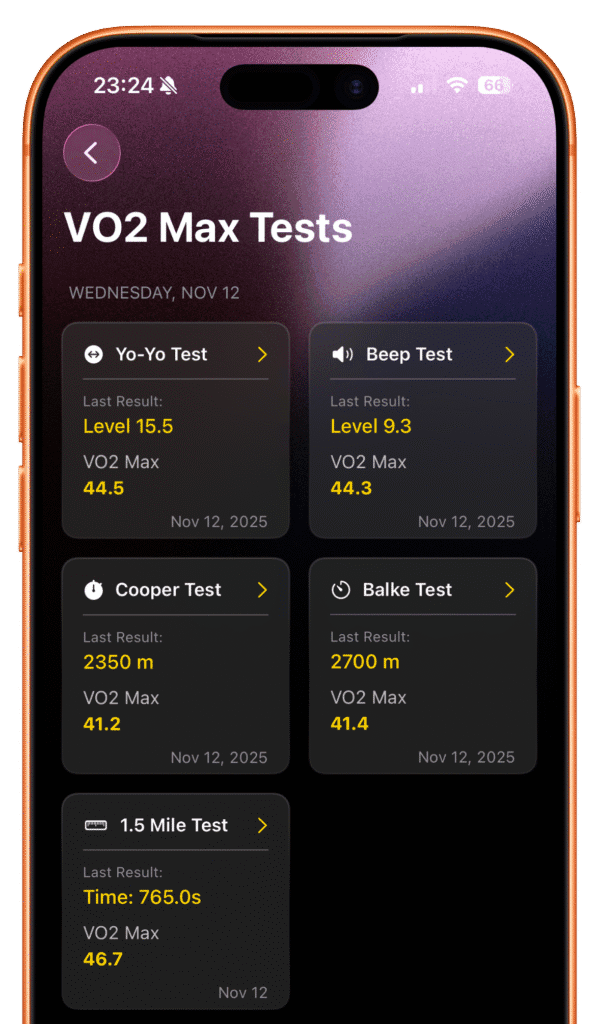
The mechanics of getting good field-test data are simple in theory and difficult in practice. Same protocol every time, same time of day, same warm-up, same hydration, same surface, same shoes, same weather window if possible. The step-by-step beep test instructions walk through the controlled setup that minimizes test-day variance, and the same logic applies to the other field tests. If your field-test results are bouncing around, the issue is almost always the controls, not the protocol.
Pick by sport. Endurance runners get the cleanest signal from the Cooper or Balke. Team-sport athletes are better served by the Yoyo, which captures the recovery component their sport actually demands. Tactical fitness candidates default to the 1.5-mile run because that is the test they will be measured on. The full ranked comparison is in the beep test alternatives ranked, and the dedicated walk-throughs of the Cooper test on Apple Watch, the Balke version, and the 1.5-mile version cover the protocol details for each.
Can the Apple Watch really estimate VO2 max?
Yes, with caveats. The Cardio Fitness number Apple shows in the Health app is computed from your routine outdoor walks and runs using a regression developed in collaboration with the Apple Heart and Movement Study at Brigham and Women’s Hospital. The standard error against lab testing is around 5 to 8 mL/kg/min, which is wider than a field test but still useful for trending.
Two things matter for trusting the wrist number. First, it relies on having enough outdoor running data with stable GPS for the algorithm to recognize a sustained-pace effort against your heart-rate response. If you mostly walk or train indoors, the Cardio Fitness estimate will lag behind reality by weeks. Second, it averages over a 30-day rolling window, so a recent fitness change shows up gradually. A great test result this week will not move the wrist number until the algorithm has enough fresh data to reweight the average.
Garmin and Polar use similar regressions with their own sensors and algorithms. Garmin in particular has been refining the FirstBeat algorithm for over a decade and the resulting estimate sits in the same accuracy band as Apple’s. None of these wrist estimates is a substitute for a real test, but all three are reasonable for tracking direction of travel between actual measurements.
Which VO2 max testing method should you pick?
All three, in sequence. Anchor with one lab test if you can afford it. Track with a field test every 4 to 6 weeks. Watch the trend on your wrist between formal tests. Each layer answers a question the others cannot: the lab gives you the absolute number, the field test gives you the controlled before-after delta, the wrist gives you the daily background signal.
If you only get one, choose by question. Trying to find your true number for medical reasons or to anchor a training program: lab. Trying to track whether your training is working: field test. Trying to spot when you are overreaching, illness is starting, or recovery is dragging: wrist. Picking the wrong tool for the question is the most common mistake I see in reader emails, and it leads to the kind of wide variance that gets blamed on the device when it is really a category error.
How often should you cross-check between methods?
Every 12 to 16 weeks if you have access to all three. The lab number sets a fresh anchor, the field test confirms the trend you have been tracking, and the wrist estimate gives you the background drift between anchors. If the three disagree by more than 6 to 8 mL/kg/min, that is your signal to investigate one of the controllable variables: pacing, heat, sleep, illness, or detraining.
Most of the people I have helped through this comparison end up settling into a yearly pattern: one lab test, four to six field tests, daily wrist tracking. That cadence keeps the cost manageable, gives you a defensible trend line, and surfaces real fitness changes faster than relying on any single source. If your three numbers are drifting apart and you cannot explain it, the checklist for inconsistent VO2 max readings is the next thing to read.
Frequently asked questions
Are lab tests covered by insurance? Sometimes, when ordered as part of a cardiopulmonary exercise test for a clinical reason. As a sports performance test, almost never. Check with your provider before you book.
Can I use a treadmill at home with a chest-strap heart-rate monitor as a substitute for the lab? No. Submaximal heart-rate prediction at home gets you a rough estimate, not a measurement. The error band is similar to the wrist watch, sometimes worse because you cannot replicate the lab ramp protocol on a home treadmill.
If my Apple Watch and my Cooper test disagree, which one is right? The Cooper test, usually, because it is closer to a maximal effort. Treat the watch as the trend and the field test as the periodic check.
Want to run all five validated field tests from the same app and compare results without doing the math by hand? Vo2 Maximizer handles the Cooper, Balke, Yoyo, beep, and 1.5-mile protocols on Apple Watch and iPhone, applies the right regression for each, and stores every result on a single timeline so you can spot the trend across methods.
Once you have picked the test, the training side is the next question. The HIIT for VO2 max guide walks through the seven protocols that produce documented VO2 max gains in 6 to 12 weeks.
Beyond VO2 max testing, the same beep test data can reveal lactate threshold if the analysis is done correctly. The lactate threshold pillar covers why LTHR predicts endurance performance better than VO2 max for most race distances.