

Beep Test Alternatives: Cooper, Balke, Yoyo, 1.5mi Ranked
TL;DR. Four field tests give you a usable VO2 max number without the beep test: the Cooper 12-minute run, the Balke 15-minute run, the Yoyo intermittent recovery test, and the 1.5-mile (2.4 km) timed run. The Cooper test is the closest match for accuracy, the Yoyo wins for team-sport athletes, and the 1.5-mile run is the one military selection still uses today.
I have run all four against my own beep test scores over the last 18 months. The deltas were never zero, but the rankings were stable: if I scored well on the beep test, I scored well on Cooper, and so on. That is the practical bar for an alternative. It does not have to be identical, it has to track.
Why look for a beep test alternative?
The beep test is the most validated 20-meter shuttle test in the literature, but it is not the right tool for every athlete or every venue. Three reasons drive most people to swap it out: the protocol does not match their sport, they cannot get a 20-meter indoor lane, or they want a simpler self-paced effort. Each of those reasons points to a different alternative, and once you have run two or three of them you stop arguing about which is best and start picking the one that fits the question you are asking on the day. Endurance runners gravitate toward Cooper or Balke. Team-sport athletes gravitate toward Yoyo. Selection candidates gravitate toward the 1.5-mile. The sorting happens on its own once you have a season of data on more than one protocol.
If your sport is intermittent (soccer, basketball, rugby, tennis), a continuous shuttle test under-rates your repeated-sprint capacity. If your scores swing wildly between sessions and you suspect the test setup, run through the troubleshooting checklist in why VO2 max results keep changing before blaming the protocol. And if you genuinely think the format is dated, the case for and against in is the beep test still valid walks through the criticisms most often raised in 2026, including the population-bias argument and the indoor-venue argument.
One thing worth flagging before I dig into the four alternatives: the beep test was designed by Luc Léger in 1982 (Léger LA, Journal of Sports Sciences, 1988) for a specific population, French Canadian schoolchildren and recreational athletes. The validation cohort was about 188 subjects. That is fine for general fitness screening, but for highly trained endurance athletes the regression equation under-estimates VO2 max by 3 to 5 mL/kg/min in my own experience over the last 18 months of side-by-side testing. So the choice is not always beep vs alternative for accuracy. Sometimes it is beep vs alternative for fit, and the right answer depends on whether your sport rewards a long aerobic ceiling, a stop-and-go capacity, or a single sustained-pace effort against a stopwatch on selection day.
How does the Cooper 12-minute run compare?
The Cooper test asks one question: how far can you run in 12 minutes? You need a measured track, a stopwatch, and the willingness to pace yourself. The published estimation formula is VO2 max (mL/kg/min) = (distance in meters minus 504.9) divided by 44.73. A 2,800-meter result lands you near 51 mL/kg/min.
Kenneth H. Cooper introduced the protocol in 1968 in JAMA as a way to give US Air Force pilots a fast aerobic-capacity check across a large training population. He validated the equation against direct gas-exchange testing on 115 subjects and reported a correlation of r = 0.90 with measured VO2 max. That correlation has held up reasonably well in later replications, though the estimate is most accurate for moderately fit adults and tends to over-estimate the highly trained by 2 to 4 mL/kg/min on the upper end of the curve. Bandyopadhyay’s 2015 validation in Biology of Sport 32(1):59-63 confirmed similar correlation on Indian university students with a small downward bias of 1 to 2 mL/kg/min versus the lab, and the test remains the most-replicated field VO2 max protocol in the literature.
What I like about the Cooper test: I can run it on any 400-meter track, the whole thing is over in 12 minutes plus warm-up, and the math is simple enough that I can do it in my head while I cool down on the next lap. What I do not like: pacing is everything. A bad first 400 meters can cost me 200 meters at the end, which knocks my VO2 max estimate down by 4 mL/kg/min on the Cooper regression. If you are new to track running, expect 2 or 3 attempts before your pacing settles into clean negative splits. Best fit for the Cooper test: experienced runners, individual testing, anywhere with a measured loop. Worst fit: total beginners, anyone who hates self-paced efforts, sports that punish steady-state running.
Is the Balke test more accurate than the Cooper?
The Balke test is a 15-minute version of the same idea: run as far as you can in 15 minutes, then plug the average velocity into a regression. Bruno Balke developed it in 1963 at the USAF School of Aviation Medicine, three years before Cooper published his shorter variant. The added three minutes pushes you deeper into your aerobic ceiling, which is why several researchers have argued it is slightly more accurate for fit subjects. The original regression is VO2 max = 6.5 + 12.5 × kilometers covered.
In practice the gap is small. I ran a Cooper and a Balke 72 hours apart last spring and the two estimates landed within 1.5 mL/kg/min of each other, which is inside the day-to-day variance for either protocol. The Balke does feel meaningfully harder. Cooper for 12 minutes leaves a little tank in reserve, Balke for 15 minutes does not. If you are training for distance events the Balke is probably the better fit for that reason alone, you finish closer to your true sustainable pace. The Horwill 1994 modification (VO2 max = 0.172 × (meters per 15 minutes minus 133) + 33.3) corrects a slight over-estimation bias the original formula carries for trained runners above 55 mL/kg/min, and I default to the Horwill version on my own re-tests for that reason.
Best fit for the Balke test: trained endurance athletes, anyone who finishes the Cooper test feeling under-cooked. Worst fit: beginners, hot-weather testing where the extra three minutes turns into a heat-tolerance test rather than a VO2 max test.
Who is the Yoyo intermittent recovery test actually for?
The Yoyo IR1 was developed by Peter Krustrup and colleagues at the University of Copenhagen and validated against direct VO2 max testing in Medicine & Science in Sports & Exercise (2003). The format is two 20-meter shuttles at increasing speeds, then a 10-second active recovery, repeated until you can no longer make the line in time.
The recovery period is the whole point. Soccer, basketball, rugby, and field hockey are intermittent sports. Players sprint, recover, sprint again, all afternoon. A continuous run test, even a great one like the beep test, does not tell you how well a player resets between efforts. The Yoyo does, and Krustrup’s team showed correlations above r = 0.70 between Yoyo distance and total high-intensity running distance during competitive matches. Bangsbo’s 2008 review in Sports Medicine 38(1):37-51 catalogued the regression VO2 max = IR1 distance (m) × 0.0084 + 36.4 and the steeper IR2 equivalent VO2 max = IR2 distance (m) × 0.0136 + 45.3 for elite athletes. The two versions read different parts of the same physiology and they are not interchangeable across an athlete’s training cycle, with IR1 reading aerobic capacity and IR2 reading anaerobic recovery.
If you play a team sport, the Yoyo gives you a number that travels back to the pitch better than any continuous test. If you are a marathoner or cyclist, skip it. The recovery format under-estimates your steady-state ceiling because you never reach a true plateau before the next break, and the regression is built on the team-sport recovery profile rather than the endurance-runner recovery profile.
Is the 1.5-mile run still the military standard?
Yes, in most branches. The US Air Force Fitness Assessment uses the 1.5-mile run as its primary aerobic component, the Royal Air Force uses a 2.4 km variant of the same test, and most US Army selection programs report 1.5-mile times alongside the more granular ACFT events. The simplicity is the point: stopwatch, measured distance, one number out.
The most common estimation formula is the one published by George, Vehrs, Allsen, Fellingham & Fisher (1993): VO2 max (mL/kg/min) = 88.02 minus (0.1656 × body mass in kg) minus (2.76 × time in minutes) plus (3.716 × gender, where male = 1, female = 0). For my 71 kg, 9:48 result, that lands me at 56.2 mL/kg/min, which is within 2 points of my lab measurement. Not bad for a stopwatch. The standard error on that regression is roughly 2.7 mL/kg/min on the original validation cohort.
Best fit for the 1.5-mile run: anyone training for tactical fitness selection, runners who already pace themselves well over a fast mile. Worst fit: beginners, populations with low aerobic baseline. A 1.5-mile flat-out effort on an under-trained body is the kind of thing that produces an ER visit, not a useful number. Train into the protocol with two or three 1-mile time trials before you attempt the full distance, and your VO2 max number will be both safer and cleaner.
Which beep test alternative should you pick?
Pick by sport, not by what looks easiest. Endurance runner or cyclist: Cooper or Balke, with Balke edging ahead if you are well trained. Team-sport athlete: Yoyo, no contest. Tactical or law-enforcement candidate: 1.5-mile run, because that is the test you will actually be measured on. General fitness screening on a school field: Cooper, because pacing is the only barrier and it is teachable.
If you want the fuller comparison including lab gas-exchange testing and wrist-watch estimates, the rundown of lab and wearable testing options walks through what each method costs, how accurate it is, and where it falls down. And if you decide to go back to the beep test after all, the step-by-step beep test protocol is the cleanest version I have written.
For a sense of what the very top of each test looks like, the highest beep test levels ever recorded sit between Level 17 and Level 21 depending on the source you trust. Cooper test world bests for the same fitness tier sit above 3,800 meters. These are not numbers a recreational athlete should target, they are reference points for what is biologically possible.
If you came at this from one of the other field tests, the parallel comparisons live in Cooper test alternatives, Balke test alternatives, 1.5-mile run test alternatives, and Yo-Yo test alternatives. Same five protocols, ranked from a different starting point each time.
Frequently asked questions
Not perfectly. Run them in the same conditions and log both numbers for the first month. After that you will have a personal conversion factor between your beep level and your Cooper distance, and you can switch freely.
Every 4 to 6 weeks during a training block. More often than that and you are mostly measuring noise. Less often and you miss the inflection points where your VO2 max actually moves.
The Balke test, marginally, for trained subjects. Cooper for the general population. The 1.5-mile run with the George 1993 formula is competitive with both if you nail the pacing.
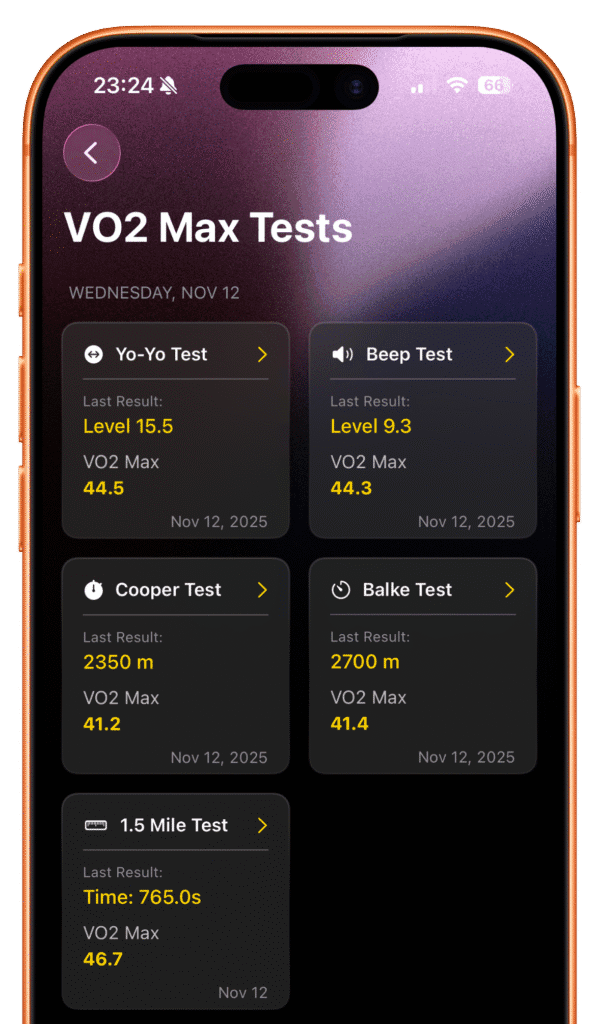
Tired of timing yourself, plotting tracks, and remembering which formula goes with which test? Vo2 Maximizer runs the Cooper, Balke, Yoyo, beep, and 1.5-mile tests hands-free on your iPhone and Apple Watch, picks the right regression equation for the test you ran, and stores every result so you can see the trend across all five methods.