Apple Watch Yoyo Test: Hands-Free VO2 Max
Run the Yoyo intermittent recovery test on your Apple Watch with haptic cues. Hands-free protocol for soccer, basketball, and team-sport athletes.
The Yoyo Intermittent Recovery test on the Apple Watch gives team-sport athletes a VO2 max number that actually maps to match-day performance. Twenty-meter shuttles, 10-second active recovery, haptic taps for every cue, no phone in your hand. The protocol below is the IR1 version validated by Krustrup and colleagues, which is the one that translates cleanly to soccer, basketball, rugby, and field hockey demands.
I have run the Yoyo on the Apple Watch through two pre-seasons with a recreational soccer side and on myself for cross-comparison against the beep test. The numbers track each other with predictable offsets: the Yoyo distance correlates strongly with high-intensity match running, the beep test does not. If you play a stop-and-go sport, the Yoyo is the field test that matters. The Watch is what makes the protocol portable.
What does the Yoyo test measure that the beep test does not?
Recovery between repeated sprints. The Yoyo IR1 alternates 40-meter shuttle runs (two times 20 meters) with a 10-second jog or walk recovery period, repeated at progressively faster speeds until you cannot make the line in time. The beep test, by contrast, is continuous, which means it never asks how well you reset between hard efforts.
Peter Krustrup and his colleagues at the University of Copenhagen validated the protocol in Medicine & Science in Sports & Exercise (2003) by testing 17 elite male soccer players on both the Yoyo and direct VO2 max. The Yoyo distance correlated with measured VO2 max at r = 0.81 and with high-intensity running covered in matches at r = 0.71. That second number is what the beep test cannot produce, because the beep test does not have the recovery component that maps onto match demands.
If your training history is mostly continuous running, switching to the Yoyo will feel awkward for the first two or three sessions. The deceleration before each turn carries more energy cost than continuous shuttle running, and the brief recovery period feels too short to actually recover. Both feelings calibrate within a few sessions.
How do you set up the Yoyo on the Apple Watch?
Mark a 20-meter lane with cones, plus a recovery zone of about 5 meters behind one of the lines. Open the Yoyo protocol on the Watch, set haptic feedback to High, set the audio source explicitly to AirPods or speaker, and start the test. The Watch handles the cue timing, the recovery countdown, and the level transitions automatically.
The recovery zone is the bit most beginners forget to mark. After every two-shuttle pair you have 10 seconds to walk into the recovery zone, turn around, and be ready at the start line for the next pair. Without a marked recovery zone people drift back across the start line during recovery and lose 0.5 to 1.0 seconds on the next shuttle, which is enough to fail a level you would otherwise complete.
The companion walk-throughs of the Balke version on the Apple Watch and the Cooper version on the Apple Watch cover the same setup pattern for continuous-run protocols. The Yoyo just adds the recovery-zone management on top.
What pacing strategy works for the Yoyo?
Match the cue cleanly through the early levels and use the full 10-second recovery. The temptation is to cut the recovery short to feel more in control, but that is exactly what produces a positive split: you feel strong through Level 14 and then collapse on the first shuttle of Level 16. Walk slowly during the recovery, breathe deeply, and arrive at the start line about 2 seconds before the next cue.
The other pacing trap is over-running the line. The Yoyo penalizes deceleration more than the beep test because each turn is followed by another full 20-meter sprint within seconds. Sloppy turns cost you energy you cannot recover. Practice your turning technique on a few easy shuttles during the warm-up and keep your foot plant just inside the line, not 2 meters past it.
How accurate is the Apple Watch Yoyo result?
Within 3 to 5 mL/kg/min of a lab gas-exchange test, in trained subjects, when the protocol is run cleanly. That is the same accuracy band as the beep test on the Watch, which makes sense because both tests use shuttle-style maximal effort estimation with a similar regression structure.
The Watch itself adds essentially no error to the protocol. The cue timing is identical to a stopwatch-based version of the test, the haptic feedback is consistent across sessions, and the level reading at the end is read straight from the protocol clock. If your Yoyo numbers are inconsistent across sessions, the cause is almost always one of the variables in the checklist for why VO2 max scores fluctuate: temperature, hydration, sleep, pacing, or surface.
When is the Yoyo the wrong test?
For continuous endurance athletes. If you run a marathon, ride a 100-mile bike race, or train primarily for steady-state efforts, the Yoyo will under-rate your aerobic ceiling because the recovery format never lets you reach a true plateau. Use the Cooper, Balke, or 1.5-mile run instead.
The Yoyo is also a poor choice for screening untrained adults. The recovery-and-sprint format requires comfortable acceleration mechanics, and beginners typically lack those. A continuous run test like Cooper or even the standard beep test is friendlier for first-time testers. The IR1 belongs in the toolkit of someone who already plays an intermittent sport and wants a number that maps to that sport.
Frequently asked questions
Is there a Yoyo IR2 protocol? Yes. IR2 starts at higher speeds and is intended for elite intermittent-sport athletes. The IR1 is the right starting point for anyone other than professional players.
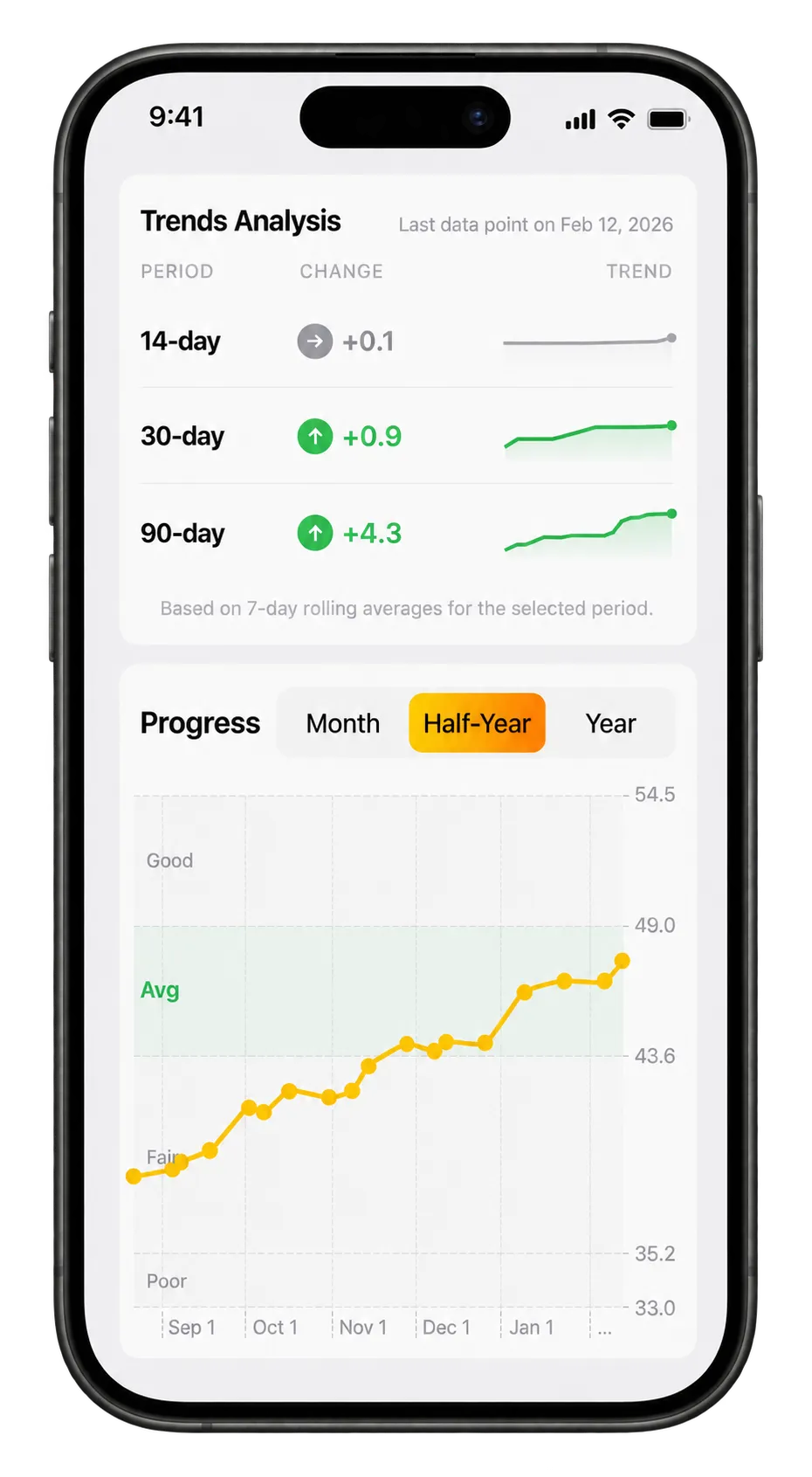 VO2 Max progression tracking directly in the iPhone app.
Can I run the Yoyo solo? Yes, especially on the Apple Watch where the haptic cues handle the timing. A second person to judge the line is helpful past Level 16, when fatigue starts to blur your own judgment of whether you made it.
How does the Yoyo compare to the beep test on the same fitness? Most adults score about 1.5 to 2.0 levels lower on the Yoyo than on the beep test, in absolute terms, because the recovery format keeps you at higher peak speeds. The VO2 max conversion accounts for this, so the estimated number lands close, but the level numbers are not comparable.
Want the Yoyo running on your wrist with no setup overhead? Vo2 Maximizer handles the haptic cues, the 10-second recovery countdown, and the level transitions automatically, and stores the result alongside your beep, Cooper, Balke, and 1.5-mile history.