

What Your Beep Test VO2 Max Score Actually Means
TL;DR. A beep test result of Level 9.4 lands roughly at 43 mL/kg/min of VO2 max, Level 12.7 at 56 mL/kg/min, Level 15.0 at 65 mL/kg/min. The number itself only matters in context: where you sit on the percentile chart for your age, whether the result is reliable, and what the test is actually telling you about your cardiovascular health. The level is the easy part, the interpretation is the rest of this article.
I have been running my own beep test every six weeks for the last two years. My personal range moves between Level 9 and Level 11 depending on temperature, sleep, and how much I have run that week. The level is meaningful, the variance around it is meaningful too, and most articles online talk about the first part and skip the second.
Where do you actually stand on the current fitness percentile chart?
The fitness standards have evolved significantly over the past few years. Many online charts you will find are outdated or based on limited populations. Here are the best current evidence, coming from the 2022 Fitness Registry and the Importance of Exercise (FRIEND), a national database of VO2 values (treadmill values, in ml/kg/min).
Male VO2 Max Data per percentile
| Perc. | 20-29yo | 30-39yo | 40-49yo | 50-59yo | 60-69yo | 70-79yo | 80-89yo |
|---|---|---|---|---|---|---|---|
| 90 | 57.8 | 54.3 | 49.5 | 42.7 | 36.4 | 29.6 | 23.6 |
| 80 | 54.2 | 48.7 | 44.0 | 37.5 | 31.6 | 26.3 | 21.8 |
| 70 | 50.9 | 45.1 | 40.0 | 34.1 | 28.7 | 23.9 | 20.4 |
| 60 | 48.2 | 41.9 | 37.2 | 31.8 | 26.5 | 22.3 | 18.8 |
| 50 | 45.4 | 38.6 | 34.8 | 29.4 | 24.4 | 20.6 | 17.7 |
| 40 | 42.8 | 35.9 | 32.1 | 27.2 | 22.8 | 19.3 | 16.7 |
| 30 | 39.2 | 32.8 | 29.7 | 25.3 | 20.8 | 17.6 | 16.1 |
| 20 | 34.8 | 29.4 | 26.9 | 22.7 | 18.6 | 16.0 | 15.3 |
| 10 | 28.8 | 25.0 | 22.9 | 19.2 | 16.1 | 13.6 | 13.2 |
Female VO2 Max Data per percentile
| Perc. | 20-29yo | 30-39yo | 40-49yo | 50-59yo | 60-69yo | 70-79yo | 80-89yo |
|---|---|---|---|---|---|---|---|
| 90 | 47.3 | 41.1 | 37.5 | 31.8 | 27.3 | 22.8 | 19.9 |
| 80 | 44.1 | 36.2 | 32.8 | 28.4 | 24.1 | 20.6 | 18.0 |
| 70 | 41.2 | 33.3 | 29.8 | 26.4 | 22.2 | 19.2 | 16.6 |
| 60 | 38.0 | 30.7 | 27.7 | 24.7 | 20.8 | 18.2 | 15.5 |
| 50 | 35.6 | 28.3 | 25.9 | 23.1 | 19.4 | 17.1 | 15.1 |
| 40 | 32.7 | 26.4 | 24.2 | 21.7 | 18.3 | 16.1 | 14.3 |
| 30 | 29.9 | 24.3 | 22.2 | 20.3 | 17.0 | 15.3 | 13.4 |
| 20 | 26.6 | 22.1 | 20.0 | 18.7 | 15.5 | 14.1 | 12.4 |
| 10 | 22.2 | 19.2 | 17.4 | 16.6 | 13.5 | 12.3 | 11.4 |
How to read these charts:
A VO₂ max of 38-39 ml/kg/min at age 37 for a male, places you at the 50th percentile, so right on average. With some serious plans of 12-week HIIT + tempo + lifting, you might increase it to 50 ml/kg/min and reach the 80th+ percentile, right in the good category.
The 50th percentile for a 30-year-old male sits near 40 mL/kg/min. The 75th percentile is near 47, the 90th near 54. For a 30-year-old female the same percentile cutoffs land near 28, 35, and 41.
One way I read the chart: a 30-year-old male at Level 11 (around 51 mL/kg/min) is at the 90th percentile. A 30-year-old male at Level 9 (around 42 mL/kg/min) is dead at the 50th. The gap between those two test results is one and a half levels, but it is the difference between average and well above average. Beep test increments are not linear in fitness terms.
What does a beep test level translate to in VO2 max?
The beep test (also called the 20-meter shuttle run, or Bleep test) uses a regression equation derived from the original validation paper by Luc Léger published in Journal of Sports Sciences (1988). The simplified version most commonly used in field testing is VO2 max (mL/kg/min) = 31.025 + 3.238 × V (final speed in km/h) minus 3.248 × age + 0.1536 × V × age. For a 30-year-old finishing at Level 11.0 (final speed 13.5 km/h), that lands you near 51 mL/kg/min.
The reason most beep test apps just hand you a level number rather than a full equation: the level alone is only loosely meaningful without the runner’s age and body weight. The full level conversion table that does the math properly across age groups is in the beep test level table and VO2 max formula.
Quick reference points if you want to translate your own number on the back of an envelope: Level 7 sits around 35 mL/kg/min, Level 9 around 42, Level 11 around 51, Level 13 around 60, Level 15 around 65. Add or subtract roughly 2 mL/kg/min for each decade above or below age 30. These are rough, but they are good enough for the kind of decision you make based on a single test.
Is your VO2 max actually healthy?
Above the 50th percentile for your age and sex, yes. Below the 25th, that is the zone where the mortality data starts to look concerning. The Mandsager et al. Cleveland Clinic study in JAMA Network Open (2018) tracked 122,007 patients and found that aerobic fitness predicted long-term mortality more strongly than smoking, hypertension, or diabetes.
The actionable framing is roughly this. If your beep test maps to a VO2 max above the 50th percentile, you are doing better than half of your peers and the mortality curve is in your favor. If you are below the 25th, the gap to average is the most cost-effective health investment you can make. The full review of the longevity literature is in what VO2 max says about lifespan, including the dementia and cancer cohorts that map fitness to disease-specific mortality.
How does your score compare to the world records?
The verified upper limit of human VO2 max sits around 96 to 97 mL/kg/min, established by Norwegian cyclist Oskar Svendsen in lab testing reported in 2012. Cross-country skiers and elite cyclists routinely test in the 80s. The full ranking of the highest individually documented numbers is in VO2 max world records.
For perspective: a Level 17 beep test score, which is at the very top of any published beep test world record list, maps to a VO2 max in the high 70s. To get into the 90s you would need a level the standard 20-meter protocol does not even encode, which is why elite athletes get tested in labs rather than gymnasiums. The beep test ceiling is not the same as the human ceiling.
Career and Sport Specific VO2 Max Standards
Your VO2 max requirements depend heavily on what you are trying to accomplish. Different activities demand different levels of VO2 max:
Military and Public Safety:
- Police officers: Typically need 42+ for men and 35+ for women
- Firefighters: Often require 45+ for men and 38+ for women
- Military personnel: Standards vary by role, generally 40+ for men and 32+ for women
Recreational Sports:
- 5K running (competitive): 45+ typically needed for good age group performance
- Soccer/football: 50+ for competitive level play
- Cycling (recreational): 40+ provides good endurance for long rides
- General fitness: 35+ for men and 28+ for women covers most recreational activities
Elite Athletic Performance:
- Distance runners: Often 65 to 85+ ml/kg/min
- Cyclists: Typically 70 to 85+ ml/kg/min for professional levels
- Soccer players: Usually 55 to 65+ ml/kg/min for elite levels

The key insight:
Match your goals to realistic standards. You do not need elite athlete numbers to be healthy, enjoy recreational sports, or even compete successfully in age group events.
Why does the number move week to week?
Test-day noise. Real VO2 max changes by 0.5 to 1.0 mL/kg/min per month at most in trained adults. The week-to-week swings you see are almost always coming from temperature, hydration, sleep, pacing strategy, or the test setup itself. The full troubleshooting checklist is in why your VO2 max number keeps moving.
The shortest practical fix is to standardize the test conditions and treat any single result as a noisy estimate. Run the same protocol on the same surface at the same time of day, and look at the 30-day rolling average rather than the latest reading. Most of the apparent volatility disappears once you stop trusting individual test results.
What should you actually do with your VO2 max score?
Three things. Use it as a baseline before starting a training block. Re-test every 4 to 6 weeks to track movement, not magnitude. Compare against the percentile chart for your age and sex, not against your friends or against the elite numbers from records lists.
If your number is below the 50th percentile and you want to move it, the levers that work are well established: zone-2 base building plus 4 to 6 weeks of well-structured high-intensity intervals. The HERITAGE Family Study cohort moved from sedentary to about 17 percent VO2 max gain in 20 weeks of standardized training, and the upper third of responders gained over 25 percent. Most of you will land somewhere in that distribution.
One last framing worth keeping in your head. The beep test gives you an estimate, the percentile chart gives you a context, and the trend over time gives you a verdict on whether your training is working. None of those three answers comes from a single test result. The score is the start of the conversation, not the end of it.
Next Steps: Turning Results into Action
Once the number makes sense, the question is how to move it. The honest answer is that the lever depends on where you start. Moving from “Fair” to “Good” mostly needs steady zone-2 mileage and a handful of HIIT sessions per week. Moving from “Good” to “Excellent” needs a structured block, periodized intervals, and patience that the curve flattens as you climb.
VO2 max responds to training, and that is what makes it useful. Genetics set the ceiling, training sets where you actually live under it. The HERITAGE Family Study found that 20 weeks of standardized aerobic work moved the average untrained adult by about 17 percent, and the top responders gained more than 25 percent. The lowest 10 percent of responders barely moved at all, which is worth knowing before you blame yourself for slow progress.
Factors That Influence Your Results
Your VO2 max is not just about your training. Several factors affect your score. Understanding them helps put your results in perspective:
Age: VO2 max typically declines about 1% per year after age 30 in sedentary people. But only about 0.5% per year in those who stay active. This is why the age adjusted standards is important. A 50 year old with a VO2 max of 45 is in much better shape than 25 year old with the same score.
Genetics: Research suggests genetic factors account for 40 to 50% of VO2 max potential. Some people are naturally gifted with higher cardiovascular capacity. Others have to work harder for the same numbers. Focus on your personal improvement, and do not compare yourself to others.

Training Status: Regular aerobic exercise can improve VO2 max by 15 to 25% in most people. The biggest gains come from going from sedentary to moderately active. Elite athletes might see smaller percentage improvements but from much higher baseline.
Body Composition: VO2 max is expressed per kilogram of body weight. So carrying excess weight can lower your score even if your cardiovascular fitness is good. This is why the measure works well for athletic performance but should be interpreted carefully for health assessment.
Environmental Factors: Altitude, temperature, humidity, and even the testing surface can affect results. If you are tested under challenging conditions, your score might not reflect your true capacity.
Tracking Progress Over Time
The test starts paying off the second time you run it. A single number is a snapshot. Six months of numbers, run on the same surface at the same time of day, give you the only honest read on whether your training is actually working. The 30-day rolling average is what I look at, not last Sunday’s result.
Meaningful improvement timelines:
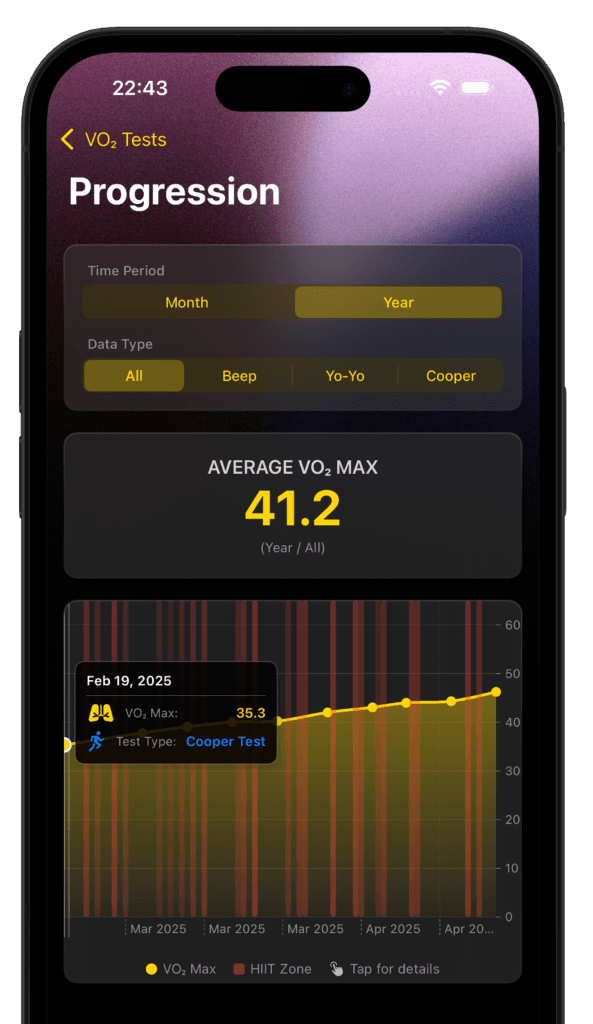
- 4 to 6 weeks: You might see 2 to 4 ml/kg/min improvement with consistent training
- 3 to 6 months: Expect 5 to 8 ml/kg/min improvement with structured aerobic training
- More than one year: Well trained individuals might see 3 to 5 ml/kg/min annual improvements
What is considered as significant change? Improvements of 2 plus ml/kg/min represent real fitness gains. Smaller changes could be due to normal variation related to testing, especially if the testing conditions are variable.
Ready to start improving your VO2 max? Our Vo2 Maximizer app makes progress tracking effortless by storing all your test results and showing clear trends over time. It integrates seamlessly with your Apple Health data.
Frequently asked questions
What is a good beep test level for a 30-year-old? Level 11.0 puts you at the 90th percentile of healthy civilian adults. Level 9.0 is around the 50th. Level 7.0 is the bottom of the average band.
Does the Léger formula work for women? Yes, the regression coefficients are sex-neutral, but the percentile cutoffs are different. Use the FRIEND chart for your sex when you interpret the result.
What does Level X.Y mean exactly? The integer is the level (the speed band you finished). The decimal is the shuttle within that level you completed before failing. Level 11.4 means you finished four shuttles into Level 11 before missing the line.
Want to skip the manual conversion and see your percentile rank, fitness age, and 30-day trend instantly? Vo2 Maximizer runs the beep test on your Apple Watch or iPhone, applies the Léger formula, and places you on the FRIEND civilian chart automatically.